
Prime Minister Narendra Modi on Thursday address Members of the British Parliament in London where he promised to open more doors of cooperation between the two countries and delved on issues like terrorism and United Nations reforms.

Rajaram Panda explains why the US president needs to restrain himself and build a relationship with China to put any credible pressure on North Korea.
'It is very much a danger.' 'With Tibet following the India tradition of ahimsa and the global visibility of the Dalai Lama who embodies these values, he should be supported by India as a diplomat.' 'It would be in India's self-interest and instead of being embarrassed about his presence, India should recognise this (role).' 'By appeasing China, India does not get anything in return; they (the Chinese have not stopped) claiming Arunachal, part of Kashmir, etc.'

Here's the full text of Prime Minister Narendra Modi's address to the United States Congress.

Biometric authentication is based on the unscientific and questionable assumption that there are parts of human body that does not age, wither and decay with the passage of time.

'Xi Jinping is keen that the second Trump-Kim summit happens soonest.' 'Kim is reported to have told Xi that he expects to achieve a result from a second summit that the international community would welcome,' points out Dr Rajaram Panda.

They bent rules. Shut down haters. And inspired many with their successes. Let them inspire you too!
Following is the full text of Prime Minister Narendra Modi's address from the ramparts of the Red Fort on the 73rd Independence Day.

'If the dimensions of the strategic partnership worked out by India and the US seem like a grand alliance targeted at you-know-who, China had better realise that it has fathered it,' says B S Raghavan, a long time observer of China.

I am only suggesting greater sensitisation and understanding of adults' sexual and lifestyle choices, says Shekhar Gupta.

Dr P K Menon, Chief Scientist and CEO, Optimal Synthesis Inc, who worked with Dr A P J Abdul Kalam early on in his career, recalls what it was like working for his first boss.

November 12 marks 25 years of the beginning of the World Wide Web. Shivanand Kanavi gives us the story of how it all began.

'Modi's campaign has been strikingly devoid of anti-Muslim rhetoric. After the kutta pilla incident, it has been several months since he said something horrible about the Muslims of India. It is the result of democratic constraints. He has to make compromises... He's trying to reinvent himself. He will politically hurt himself if 2002 becomes the definition of Mr Modi again', says political scientist Ashutosh Varshney.

'The Modi-Xi and Modi-Obama meetings, with an interval of just 12 days, are juxtaposed superbly at a crucial point in the prime minister's life. Can Modi carve out a win-win situation with the superpower and the emerging superpower at the same time?'
India's commitment to an open and plural security architecture attests to the fact that Asia's transition is a dynamic of both power & identity, says Zorawar Daulet Singh
The kind of people Narendra Modi has chosen, the decisions he has taken and the rail and central budgets suggests that he is treading carefully in New Delhi. There is less of innovation and more of continuity, so far. He is not ready to rock the boat and start from scratch, says Sheela Bhatt.

India has made a remarkable journey from a top-down system of economic decision-making to one that unleashed our entrepreneurial spirits but the next big jump lies in enhancing the quality of our tale.

'Muslims, like people of all other faiths, are quite comfortable with the idea of nationalism and democracy today. But are they following Islam in its spirit? That is a different question.'

Hein Kiessling has the kind of access in Pakistan that journalists (and spies) would die for, says Kanika Datta.
.jpg)
Ayurvedic expert Dr G G Gangadharan on how the ancient Indian medical practice needs to be propagated in the country of its origin

India has built two top-secret facilities in Karnataka to enrich uranium in pursuit of its hydrogen bomb dream.

The remarkable story of Wing Commander Rakesh Sharma, the first Indian in space, will be seen in a film featuring Aamir Khan.

After Pyongyang tests a missile potentially capable of reaching the US, Dr Rajaram Panda explores the realistic -- and peaceful -- options before Donald Trump and the international community at large.

'The creation of Pakistan was integral to Britain's grand strategy.' 'If they were to ever leave India, Britain's military planners had made it clear that they needed to retain a foothold in the NWFP and Baluchistan because that would provide the means to retain control of Iran, Iraq, Kuwait, the UAE, Bahrain and Qatar.'

'We should not flatter ourselves that China is fixated on encircling India. She has greater goals, becoming the pre-eminent power in the world, and India as a major power is dealt with as part of that strategy.'

The facts remain cloaked in mystery, but the legend goes that Talpade had created a flying machine powered by mercury and solar energy, and based on ideas outlined in Vedic texts.
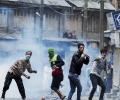
'Burhan Wani's killing served as a spark for the anti-establishment fire that has been raging in the minds of Kashmiris ever since the Centre stopped engaging them for their political future,' says Air Vice Marshal (retd) Kapil Kak in an interview with Rediff.com

'It would not be incorrect to say that the Chinese-Pakistani strategy of containing India began in the aftermath of the 1965 war.'

The journey of Abhijit Avasthi, the former national creative director of Ogilvy & Mather, is as amazing as it is unbelievable. Read on!

The administration and America Inc have invested in Narendra Modi's power to transform India. Aziz Haniffa/Rediff.com reports from Washington, DC.

'In the first meeting of this new year, we took a joint new year resolution that we will complete it this year. At the time things were not very clear, but the mood was clear that yes, we must resolve it.' 'Yes, details have to come out, but there are some sensitivities, there are some stake-holders not yet on board, especially other Naga undergrounds etc, we would like them to come on board... So at a proper time it has to be revealed to the country, and to the legislature. Perhaps, we may have to wait for some more time.' 'With better understanding of the Indian system, many of them have learnt, realised, appreciated that Naga nationalist aspirations can be accommodated in the Indian system. The Indian system is pretty comprehensive and flexible.' 'A Naga has as much stake, claim over India as any other Indian. There is no distinction. This, Nagas have realised, that yes, Naga nationalist aspirations and Indian nationalism are not mutually exclusive.' Ravindra Narayan Ravi, the Government of India's Special Interlocutor for the Naga talks, explains how the Naga Peace Accord was reached in an exclusive interview to Saisuresh Sivaswamy/Rediff.com
 © 2026 Rediff.com - Advertise with us - Disclaimer - Privacy Policy - Sitemap - Feedback - About us - Terms of use - Grievances